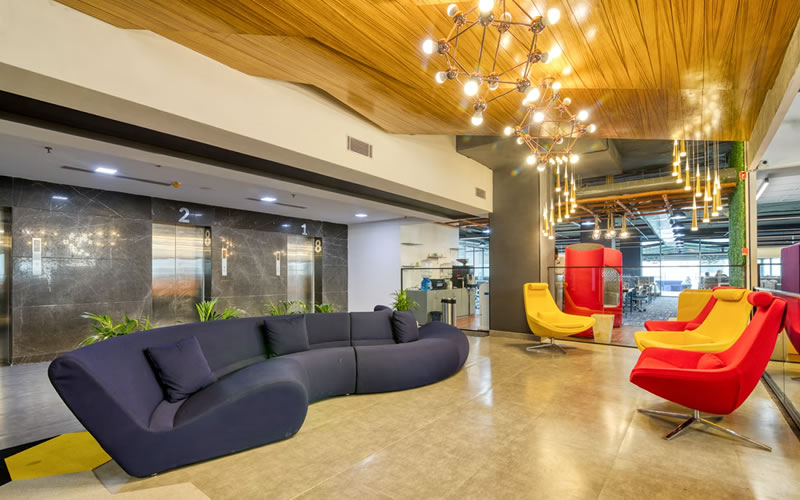
Office lighting impacts everything from employee health and productivity to visitor first impressions and business costs… is it time to consider updating your lighting?
It is fair to say, that office lighting plays a fundamental role in a company’s interior design but it is an issue that very few manage to master.
Here at Source One Consulting, our team of experienced professionals can support you through every step from audit to design and installation.
In the meantime, this guide will provide the inspiration needed to transform your office lighting setups in style.

Why is office lighting important?
Whether you are planning an office fit out or a smaller refurbishment, it is important to make sure changes will add value for money. While upgrading your office lighting solutions may be less challenging than other changes, understanding the benefits of updating your systems is important.
After all, sight is our dominant sense, and is responsible for up to 85% of our perception, which instantly gives some insight into why strong lighting plans are key. Implementing the right lighting setup, can deliver benefits in the form of;
Improved employee health. Poor lighting can lead to workers suffering eye strain and more fundamental issues such as not seeing potential hazards!
Increased productivity. Light impacts circadian rhythms and generally promotes a more positive mood for individuals and groups alike.
Improved first impressions for visitors and clients. Spaces look bigger, cleaner and more inviting – first impressions are made in as little as 7 seconds.
Increased employee happiness and pleasantness. A more pleasant working environment fosters a happier workforce.
Reduced operational costs. Better designed lighting schemes, using LED lighting and smart controls can significantly reduce energy operational costs.
Of course, there are plenty of additional benefits. For example, switching to greener lighting solutions also protects the planet and feeds into your brand image of being a socially responsible company.
Whether it’s part of a major overhaul or a standalone upgrade to the commercial office environment, new and improved lighting will work wonders for your business.
Six steps to building the best office lighting setup
When looking at the biggest trends in office design, lighting will always play an essential role.
However, it takes a conscious effort and comprehensive strategy that integrates several key features to get it right.
Whether taking the DIY route or hiring the help of a professional, the following six ingredients should be included in the recipe for success.
Adequate levels of light won’t only create a more pleasant atmosphere and serve your employees well. They also ensure that your commercial office spaces comply with all HSE regulations.
Therefore, you should always know the requirements for any given space. For example;
- Corridors may require 50 lux.
- A process control roll may require 300 lux.
- Open plan offices may require 150 lux.
The legal requirements and logistical practicalities will be determined by the type of work completed in a specific workspace and whether good visibility is required for communication.
When subsequently thinking about the positioning of your lighting fixtures – ranging from ceiling lights to lamps – you must ensure that there is suitable coverage to all parts of the room.
However, you must avoid haphazard positionings too, as this could cause accidents and disruptions. Similarly, you will need to ensure that ceiling lights are not positioned directly above working employees due to potential safety risks as well as possible glare.
Commercial buildings are expected to use 22.5 kWh of electricity per square foot per year, and lighting systems are a significant contributor.
It is possible to reduce this output by using a combination of compact fluorescent lamps (CFLs) and light emitting diodes (LEDs).
The best solutions are;
- General lighting (can use either solution).
- Outdoor lighting (can use either solution).
- Spotlighting (choose LEDs).
- Dimmable lighting (choose LEDs).
- Crystal chandelier (choose LEDs).
CFLs can use up to 80% less electricity than traditional incandescent bulbs while LEDs can use up to 90% less.
The key to success comes from finding a bulb that delivers the right level of power. A 470L bulb is the equivalent of a 40W traditional bulb while 1,520L is the same as a 100W traditional bulb.
Compact linear fluorescent lamps (LFLs) can be used to further support the transition away from outdated bulbs.
Each bulb can save several pounds of energy per year while they also last longer than traditional bulbs.
In addition to saving money, it is a smart move toward reducing the office’s carbon footprint. Dimmable features and individual spotlights also add versatility.
Commercial office spaces have several types of lighting and colour temperature working simultaneously.
You’ll have natural light entering the office through the windows while computers and digital screens produce a completely different type of light.
When working with a commercial office space, the following options can be considered;
- Warm white (3,000K) for a smooth lighting setup that highlights reds and yellow for a friendly and welcoming atmosphere.
- White (3,500K) for a dynamic yet balanced lighting environment.
- Cool white (4,100K) for a stimulating light setup that aids productivity in task-heavy working environments.
- Daylight (5,000K) for a natural light temperature that promotes an energetic vibe.
The harsh contrasts between daylight and screen lights can cause employees to strain their eyes, which is why corrective lighting can be used as a mediator.
Corrective lighting can be placed behind computer monitors to protect the worker’s eyes.
Colour correcting bulbs will additionally aid the colour temperature and reduce glare. It makes the office space look more inviting and can enhance productivity.
It is a particularly important issue when dealing with cubicle offices and closed spaces where the juxtaposition of natural lighting and screen lighting can be very harsh on the eyes and ambience of the office spaces.
While brighter lighting will be needed in areas where productivity and high energy are key, you should not be afraid to use ambient lighting or even dim lighting in other areas. Not least because 90% of workers report symptoms of light sensitivity that can impact their workflows.
Less intense lighting can be used in several ways, such as;
- Ambient lighting can be used in conference rooms or spaces where desk work is less common.
- Dim lighting can be used in staff break rooms or spaces where employees want to relax for a few minutes.
- Dim lighting can also be used in hallways, as long as there is enough visibility for safety and avoiding trips.
As with many aspects of business, striking the right balance is vital.
Employees cannot perform tasks when the lighting is too dim. Conversely, though, harsh lighting can impact productivity by causing migraines and related issues.
Before completing a new lighting installation, it’s advised that you gain feedback from employees to understand where the current lighting goes wrong.
In spaces where harsh lighting may want to be avoided, reducing the amount of overhead lighting in favour of desk lights, recessed wall lighting, and wall-mounted uplighting for a more appealing setup.
Up to 80% of all workers state that suitable lighting is important to them.
While choosing the right track lighting, spotlight, and exit sign lighting will be vital, it’s equally crucial to ensure that the amount of light delivered matches the needs of each space.
Small offices, meeting rooms, and open plan offices all have unique requirements. Some of the reasons why calculated choices are needed are;
- Some lights may cause overheating and stuffiness, particularly in smaller offices and meeting rooms.
- Excessively intense lighting can make it difficult for workers to stay in the space for long periods.
- In a room used for reading paper documents, brighter lighting is needed for optimal visibility.
It is also important to consider the spatial limitations of a room to determine the best lighting fixtures.
Using wall-mounted sconces and hanging pendants from the ceiling, for example, can become decorative features without overwhelming the space.
Crucially, all lighting plans should consider the spread of the light. This can be calculated by multiplying the angle of the light by the distance.
Packing too much or too little into an office will naturally cause problems, and rectifying this could subsequently hinder the revamped office design. When the right preparation and calculations are made before the installation, a practical setup can be achieved.
By now, the demand for versatile lighting solutions should be clear.
Not all employees have the same level of light sensitivity while some office spaces may be used for multiple functions and tasks.
Additional reasons to consider versatile lighting where the intensity can be changed include, but are not limited to;
- As natural lighting changes throughout the seasons, the intensity demands for internal office lighting may increase or decrease.
- When evening sets in, lighting can be lowered to create a more relaxed atmosphere and reduce eye strains caused by harsh light.
- For open plan offices, it can be a chance to ensure that the appropriate desks are well lit while unused areas remain dim.
Versatile lighting enables your office team to benefit from the right lighting intensity and temperature at all times. Customizable lighting solutions can add an extra layer of flexibility too.
Either way, office managers and business owners will want to ensure that all modern lighting fixtures are used in an optimised way. Having the installation team show employees the functional features can be very useful.
Meanwhile, it will feed into the other goals of reducing electrical consumption and waste while also prolonging the lifespan of light bulbs and lighting fixtures, including fixed ceiling lights, desk lighting, and more.
Build a better office today with Source One Consulting
The information above will help you consider various aspects of your light plans, ranging from the type of bulbs needed to positioning and using colour temperature to your advantage.
However, understanding the importance of office lighting and unlocking its full potential are two different things. While you might not always think it, an intricate design and installation will be required. And Source One Consulting can help.
Free Consultation…
A free consultation with our fantastic team of experts will ensure that the best office lighting choices are made for the sake of productivity, employee wellness, and your bottom line.